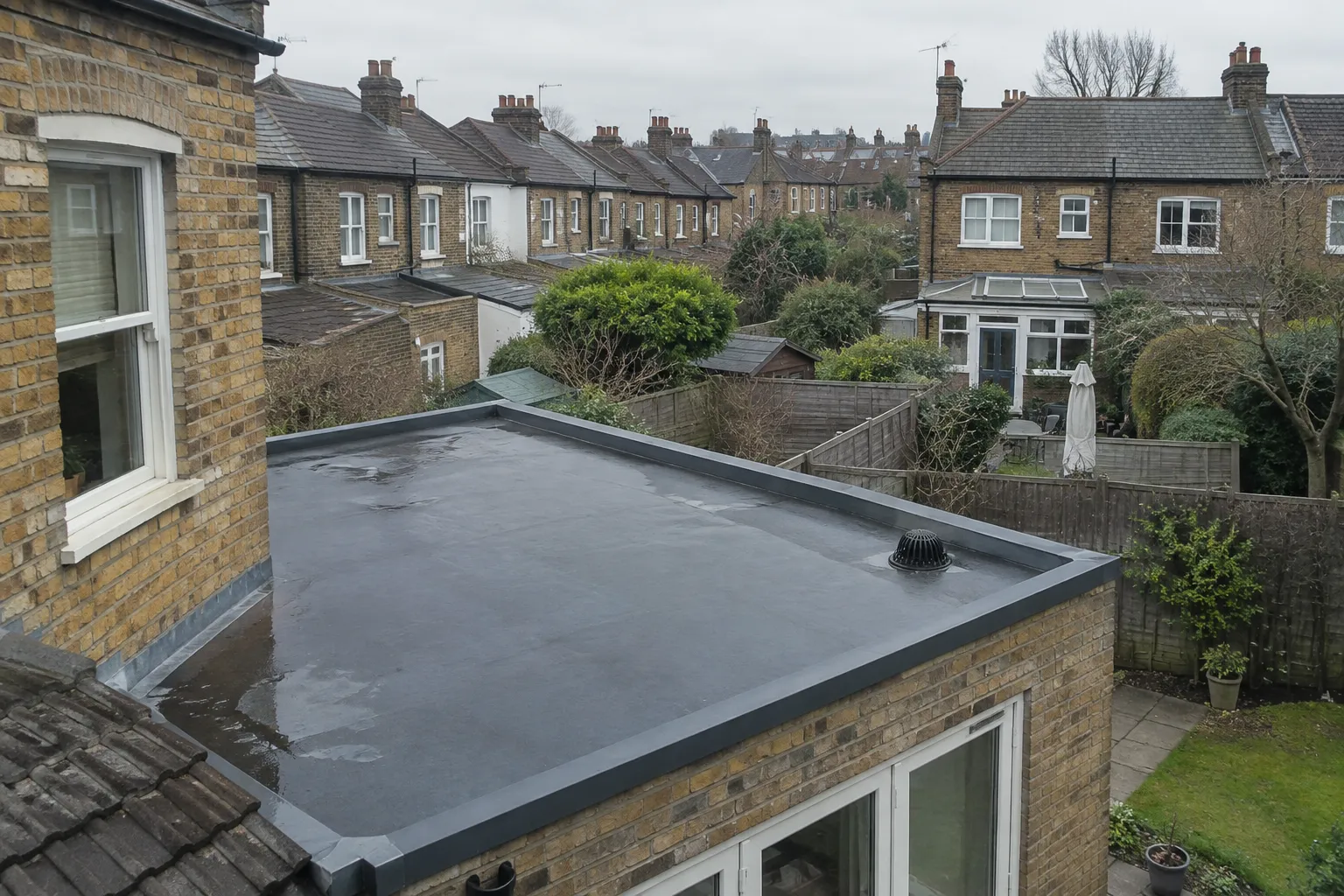
A flat roofing contractor fits, repairs or replaces a flat roof: felt, GRP fibreglass, EPDM rubber or a single-ply membrane, along with the flashings and drainage that keep water off a roof with little or no pitch. Wandsworth Roofers puts you in touch with local specialists who quote on flat roofing and flat roof repairs across the borough, from a Victorian rear extension to a modern loft conversion. What a job costs, and how long it lasts, depends on the roof's age, its covering, and how far the cracks or splits have already spread. This page covers the main flat roofing options, where the vapour barrier goes, and when a repair is enough instead of a full replacement.
What are the available flat roofing options in the UK?
The flat roofs most UK homes have are felt (built-up or torch-on bitumen), GRP fibreglass, EPDM rubber, or a single-ply membrane such as PVC or TPO. Felt is laid in bonded layers; fibreglass is built up on site from resin and glass matting into one seamless skin; EPDM and single-ply go down as one sheet with few or no joints.
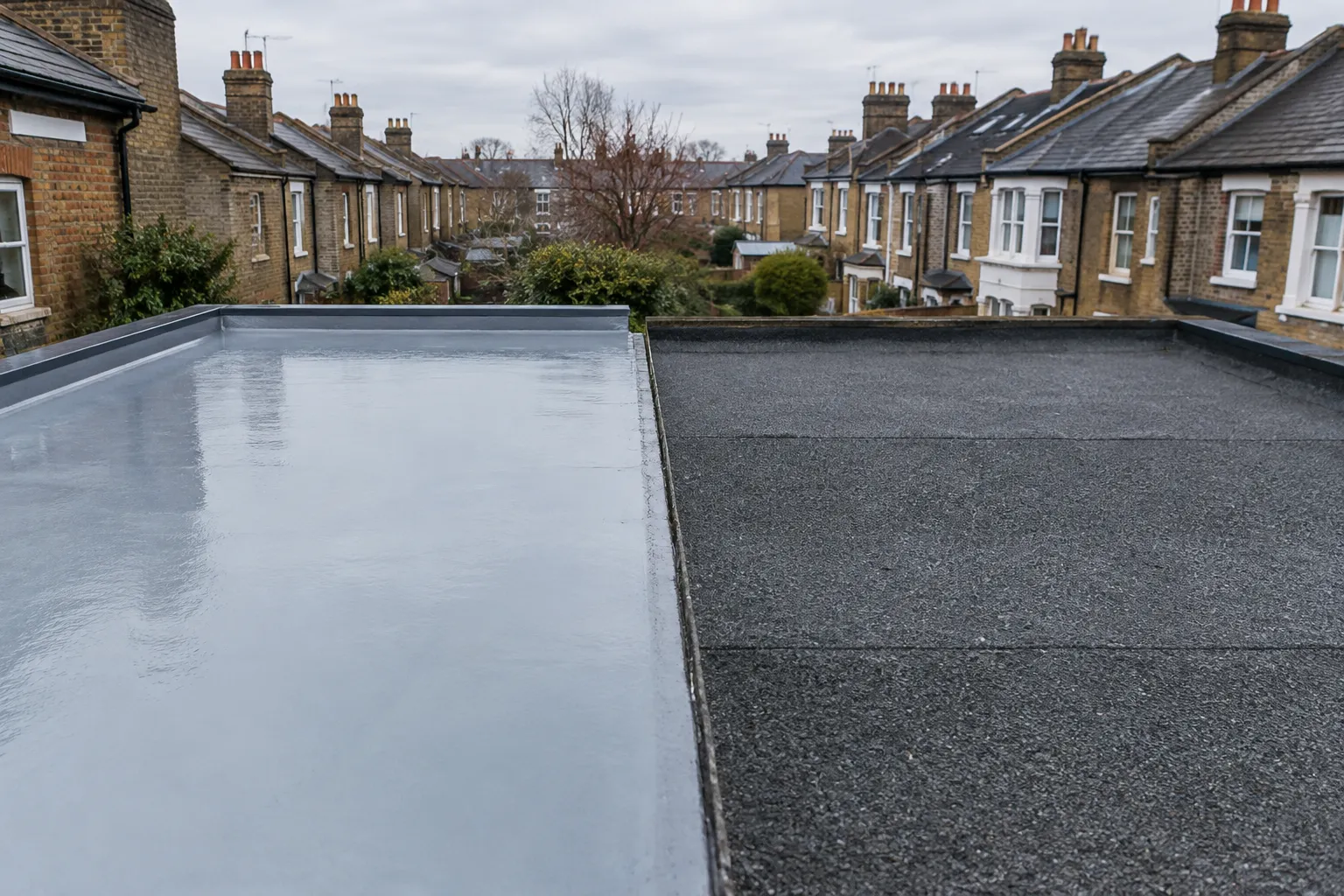
Each suits a different roof and budget:
- Felt is the most common and usually the cheapest to install, but it's built from layered sheets, so joints and upstands are where it tends to fail first, especially on an old roof that's had several repairs.
- GRP fibreglass forms a rigid, seamless surface with no joints across the main area, which suits roofs people walk on, such as a balcony or roof terrace.
- EPDM rubber is a single flexible sheet, often used where the roof shape has a lot of corners or upstands, since fewer joins means fewer places to fail.
- Single-ply membranes (PVC, TPO) turn up more on larger or commercial-style flat roofs than on a typical house extension.
A local specialist will look at the roof's size, shape, access and what it's covering before recommending which one fits.
Do I need a vapour barrier on a cold flat roof?
Usually, yes, though a cold deck flat roof (where the insulation sits below the deck rather than above it) isn't how most new or replacement flat roofs are built now. Building guidance treats cold deck roofs as acceptable only on very small areas, and even then they still need a vapour control layer, not cross-ventilation on its own, to stop moist air from the room below reaching the cold underside of the deck.
Most flat roofs fitted today are warm deck roofs instead, with the insulation above the structural deck. A warm deck design still needs a vapour control layer (often just called a vapour barrier), positioned on the warm side of the insulation, to stop the same problem happening in a different place. A specialist can tell you which build-up your roof already has before quoting on a repair or a replacement.
Where does the vapour barrier go on a flat roof?
On a warm deck flat roof, the vapour barrier sits immediately above the structural deck and below the insulation and waterproof covering, on the warm side of the insulation. That's the standard position for most flat roofs fitted on homes today.
On the rarer cold deck design, it goes the other way round: fixed to the underside of the roof joists, under the ceiling. Getting the position wrong, or leaving gaps or unsealed joints in it, lets warm moist air from the room below reach a cold surface inside the roof. The moisture then condenses, soaks the insulation, and can rot the deck from the inside, often years before anyone sees damp inside the house. It's a detail worth asking a specialist to confirm on a repair, not just a new roof.
Can I use DPM instead of vapour barrier?
Not as a straight swap. A damp proof membrane (DPM) and a vapour barrier do different jobs: a DPM is built to resist liquid water pushing up through a solid floor or slab, while a vapour barrier is built to resist water vapour spreading through the roof build-up from a warm room below. They're specified to different standards and usually sit in different places in a roof.
Some heavy-gauge polythene sheets can do either job if they're specified, positioned and sealed correctly, but that's a decision for whoever is designing the roof build-up, not a straight substitution on site. If a specialist proposes using one product instead of the other, it's reasonable to ask them to explain why it's suitable for your roof.
Questions people ask
How often should a flat roof be resealed?
There's no single fixed interval. It depends on the covering: felt usually needs its joints and upstands checked and touched up every few years, while EPDM rubber and GRP fibreglass need far less routine resealing and are mostly checked rather than recoated. An annual look at the surface, the edges and the drainage catches most problems before they become a leak.
Why does my flat roof leak in heavy rain?
Heavy rain finds weak points that light rain doesn't reach: standing water sitting over a low spot, a crack or split in an old covering, a perished upstand, or a cracked mortar fillet where the roof meets a parapet wall or chimney. Water can also travel sideways under the covering before it shows up, so a stain in the room below isn't always directly under where the leak started.
What is the best sealant for repairing a flat roof?
There's no single best sealant: the right one matches the roof's covering. A felt roof usually takes a bitumen-based repair compound, while GRP and EPDM roofs need a product made for that specific material, or they can fail to bond properly. A local specialist will check what the roof is covered in before recommending or applying anything.
What is the best way to seal a leak on a flat roof?
The best way is to find exactly where water is getting in, not just where it's showing up inside, since flat roof leaks can travel before they drip. A specialist traces the entry point, cleans the area back, and applies a repair matched to the existing covering. On an older roof with several patches already, it's worth asking whether a repair is still worthwhile or whether the covering has reached the end of its life.
Sources
Updated